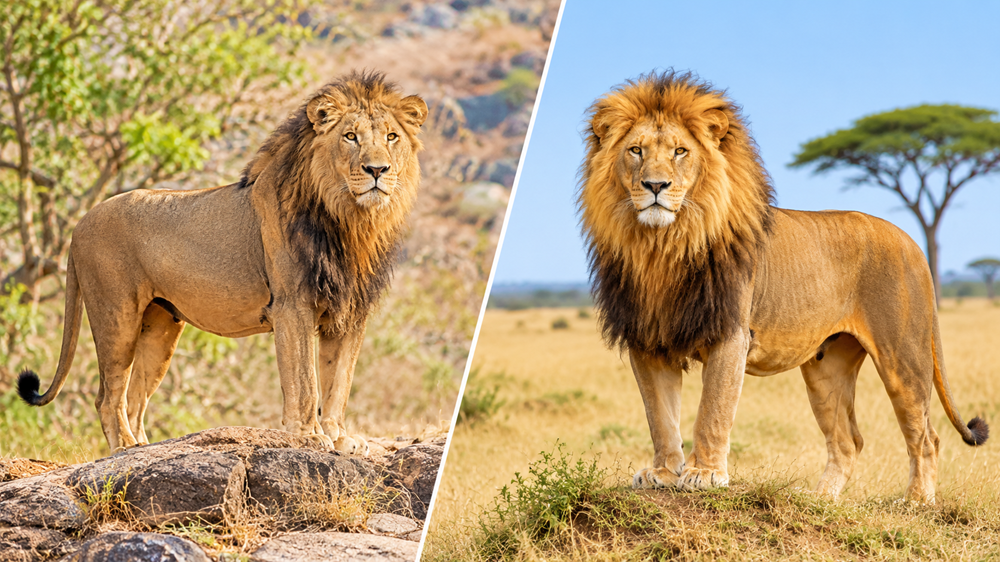
A lion is a lion at a glance. But stand in front of one in the wild and the details start to emerge. The Asiatic lion of Gujarat and the African lion of the savannas belong to the same species, but differ in looks, behaviour, habitat and conservation status. It makes it more meaningful to know what to look for.
Asiatic lions are a bit smaller, have a thinner mane that exposes the ears, have a characteristic skin fold along the belly and live in smaller groups. The African lion is bigger, has a fuller mane, hunts in bigger prides and roams open grassland. The Asiatic lions live in the wild only in and around the Gir National Park in Gujarat in India.
Where Each Lion Lives
African lions roam throughout sub-Saharan Africa, especially in savanna and grassland areas from Kenya and Tanzania to Botswana and South Africa. Asiatic lions are found in a single landscape: the dry deciduous forests and scrub of Saurashtra, Gujarat. That’s why wildlife travellers from across the globe flock to the Gir. If you intend to see them, stay at a sasan gir lion resort keep you close to the park gates and the early safari slots.
Physical Differences You Can Actually See
But most guides agree on a few things that separate the two. Here are the simplest ones to remember:
- Mane: An Asiatic male’s mane is generally shorter and less dense, so you can see his ears. The mane of an African male is denser and typically covers the ears.
- Belly fold: Asiatic lions have a skin fold that runs the length of the belly. It is common in Asiatic lions and rare in African ones.
- Size: African lions are generally a bit larger and heavier but there is overlap. Asiatic males generally weigh around 160 to 190 kg, with African males going higher.
- Tail tufts and tufts at the elbow: Asiatic lions usually have a fuller tail tuft and more prominent tufts at the elbow.
- Coat: Asiatic lions are frequently somewhat lighter, with a sandy or rufous tone.
- Skull: Differences in skull structure (especially skull bones) are cited by researchers, but you will not see this in the field.
Remember that each animal is an individual. Age, health and season all affect the look of any lion, so treat these as clues, not rules.
Social Behaviour: Two Very Contrasting Lifestyles
This is the biggest difference between the two animals and the part that surprises many of the visitors.
African lions normally live in large prides that consist of several related females and their cubs and a coalition of males. Females hunt together on the open plains, and pride numbers can easily reach double figures.
The Asiatic lion lives differently. Prides are small, often two or three related females and their young. Males usually live alone in coalitions and join a pride only for mating or territorial defense. Gir’s forest is dense and the prey is spread out, so smaller groups tend to work best. If you hear someone say they saw a huge pride in Gir, take it with a pinch of salt.
Habitat & Diet
Landscape affects the hunting and feeding of each lion.
- African Lions: In open country, hunt wildebeest, zebra, buffalo and antelope.
- Asiatic lion: Chital (spotted deer), sambar, nilgai and wild boar. Gir’s forest cover offers them places to ambush, and they also take livestock near the forest’s edge.
Here lions coexist with leopards, hyenas and other predators making for a competitive yet balanced food web. Ask your naturalist at a Gir lion resort near the park what the animals have been eating lately as this often tells you where the lions are resting.
Why Gir Matters: Conservation Status
As for the African lions, they are in the low tens of thousands and are listed as Vulnerable by the IUCN. Asiatic lions were reduced to a few dozen animals in the early 20th century, before protection in Gir helped them come back. Recent censuses by the Gujarat government put the numbers in the high hundreds, which is a hopeful trend but still a small population. The IUCN lists the Asiatic lion as Endangered.
They live in a region where any disease outbreak or natural disaster is a real danger. This is one of the reasons conservationists have long talked about creating a second home for the species. For the latest numbers, check out the latest census release from the forest department of Gujarat.
Quick Comparison
| Feature | Asiatic Lion | African Lion |
|---|---|---|
| Mane | Sparse, ears visible | Full, often covering the ears |
| Belly fold | Rare | Usually present |
| Pride size | Small | Large, often |
| Habitat | Dry deciduous forest | Savanna & Grasslands |
| Primary prey | Chital, sambar, nilgai | Wildebeest, zebra, buffalo |
| IUCN status | Endangered | Vulnerable |
How to Enjoy a Lion Sighting in Gir to the Fullest
Lions are not easy to find, and you need patience and preparation. These habits boost your chances:
- Book the early safari. Lions are most active at dusk and at dawn.
- Follow your guide’s example. Trackers read pugmarks, alarm calls and the behaviour of deer.
- Watch the plant eaters. If you see a bunch of chitals looking off in the same direction, it usually means that a predator is around.
- Be still quiet. Animals are scared away by noise and sudden movement.
- Have a safari and then another. One drive can be quiet; the next can be memorable.
A well-managed property helps here, and a base like Aranya Gir Resort makes it easier to start early as you are close to the entry points. Whatever stay you pick, do check the safari rules, permits and timings on the official Gujarat forest department booking portal as these can change.
Conclusion
Both lions are magnificent, but the Asiatic lion has a special story: a species brought back from the edge in one forest. Find out the small differences before you go and each sighting will mean more. Take an early safari, listen to your guide, and let the forest do its thing.