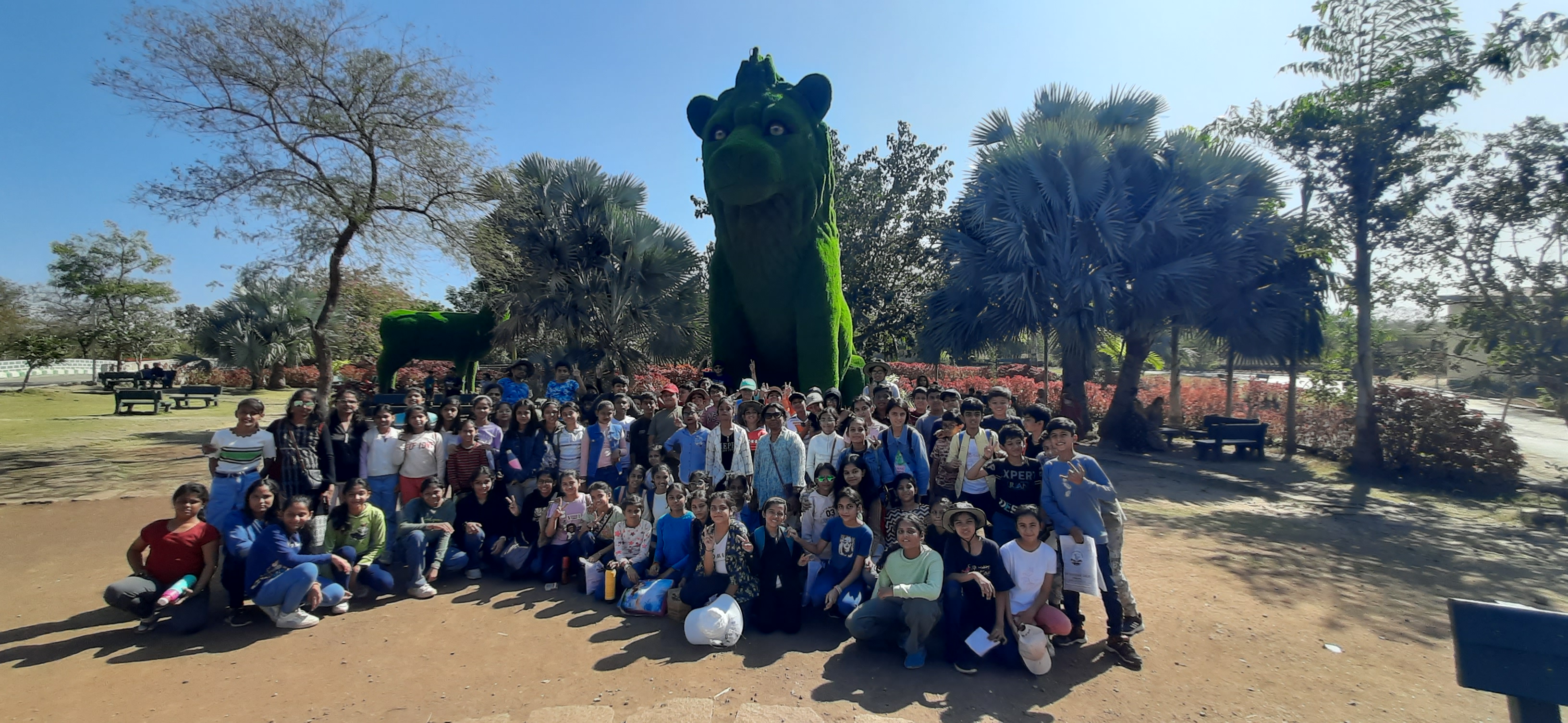
A school trip to Gir can be an experience that is far more exciting than a break from textbooks. In the forest, ideas that students normally learn through diagrams, definitions, and chapters become tangible. Food chains become evident. They can see biodiversity. Conservation is no longer just a fuzzy issue of the environment, but a matter of how people, animals, forests, and water depend on each other.
Gir has a special relationship with environmental education. Since the 1970s, the Gujarat Forest Department has been conducting nature education camps for students and teachers in the Gir forest, using lectures, discussions, demonstrations, and direct exposure to nature as learning tools – which makes Gir the perfect place for experiential learning.
1. Students Can Learn About Biodiversity in Real Life
Biodiversity can be the sound of a definition in a classroom. In Gir, students get to see what that looks like.
The landscape is host to dozens of mammal species, many reptiles, and more than 300 species of birds. The ecosystem also contains hundreds of species of plants.
A guided observation activity might have students identify:
- Different types of trees and bushes
- Carnivores and herbivores
- Birds that live in different parts of the forest
- Signs of animal movement
- Differences between woodland, grassland, and water habitats
The students do not just memorise the word “biodiversity” but indeed start to understand why different species need different resources.
2. Food Chains Are Easier to Understand
A wildlife safari is an example of a natural starting point for teaching about food webs.
Students could observe deer consuming vegetation and, later, learn how herbivores are part of the carnivore prey base. They can then discuss what happens if one part of this system changes.
A simple field exercise for teachers would be to construct a food web based on species observed during the trip.
For example:
Plants --> Chital --> Predators
But the lesson ought to be bigger. Real ecosystems are not usually simple chains. Many interrelated relationships, competition for resources, and changes caused by seasons, water availability, and human activity are present in it.
That’s when a Gir trip becomes more valuable than a textbook illustration.
3. Conservation Is Man's Responsibility
Gir is not only for animals. Its conservation story includes people and communities, too.
The official Gir conservation material details the role of local communities, Maldharis, forest management, habitat improvement, and livelihood-related initiatives.
This provides an opportunity for teachers to ask a critical question:
Can wildlife conservation succeed if we don’t think about the people living around forests?
Students can discuss issues like livelihoods, livestock, forest resources, tourism, and the responsibilities of visitors. This gives children a much more balanced understanding of conservation than just saying forests should be “protected”.
4. Observation Skills Get Better on Their Own
In a forest, attention is rewarded. Instead of asking them to take photos of everything, teachers can give them observation challenges:
- Hear five birdsongs.
- Draw three different types of leaves.
- Check for evidence of herbivore activity.
- Note differences between sunny and shaded habitats.
- Watch the way animals act around cars.
- Write down questions they can’t answer immediately.
The idea is not to turn the safari into yet another examination. It is to create curiosity.
5. Students Can Learn About Responsible Tourism
A school trip is also a chance to teach behaviour.
According to Gir’s official guidelines for visitors, tourists are specifically asked to keep silence, maintain a safe distance, refrain from feeding animals, avoid littering, and follow prescribed routes.
These rules can be used by teachers to teach an environmental lesson. Students might be asked:
- Why can’t we yell at an animal to turn its head to the camera?
- Why don’t we ever feed the wildlife?
- Why must vehicles remain on designated routes?
These simple questions teach students that responsible tourism is not simply about following instructions, but about reducing human impact.
6. Orientation Centres Can Provide Context
There is more to a well-planned educational trip than just seeing wildlife.
The Gir Orientation Centre at Sasan has information on the natural history of the Gir landscape - flora and fauna, animal behaviour, and habitat requirements. Interactive displays and models are meant to make this information easier to understand.
This is especially useful before a safari. Students can learn what they are looking for and then try to find it outside. That creates a simple cycle of:
Learn --> Observe --> Discuss
7. Pick Accommodation That Facilitates the Learning Experience
As a teacher organising a residential trip, think of your accommodation as part of the itinerary, not just somewhere to sleep.
Aranya Gir Resort is one option that could be considered when planning a school group stay, but schools should assess accommodation against their specific needs such as group size, safety, meals, transport, and suitability for students.
When comparing a nature resort in Sasan Gir, schools should also think about whether the environment allows students to responsibly observe nature outside of the formal safari hours.
The practicalities are important, and a well-structured schedule allows more time for real learning.
8. Explore the Surrounding Area Cautiously
A Gir school trip doesn’t have to be just one safari.
Depending upon the itinerary, teachers can research suitable places near Sasan Gir to supplement the educational theme. Students can learn about how the region’s identity is tied to its natural and human heritage through nearby nature-based attractions, interpretation centres, and cultural experiences.
The trick is to avoid over-stuffing one day with too many attractions. Students learn better when they have time to observe, ask questions, and discuss what they have experienced.
A Teachers’ Simple Learning Framework
- 1. Before leaving school (Prepare): Intro to Gir, species, and basic forest etiquette.
- 2. During the visit (Observe): Students should write what they see, hear, and question.
- 3. Post Safari (Discussion): Link observations to biology, geography, and environmental science.
- 4. Upon return (Reflect): Have students write or share one thing they learned that a textbook could not have taught them.
“This is the way to make a sightseeing trip a real field-learning experience.”
Last Thoughts
Gir can teach students things that cannot be recreated inside the four walls of a classroom. It can teach them that conservation is about animals, habitats, communities, water, forests, and human responsibility—and that they all are connected.
Gir is no stranger to this educational approach, as is evident from the Gujarat Forest Department’s long-running nature education program.
So, it’s possible that the most valuable thing for schools to take away isn’t the photograph of a lion. Perhaps it is a new habit for students to look more closely at the natural world and ask what can be done to protect it.